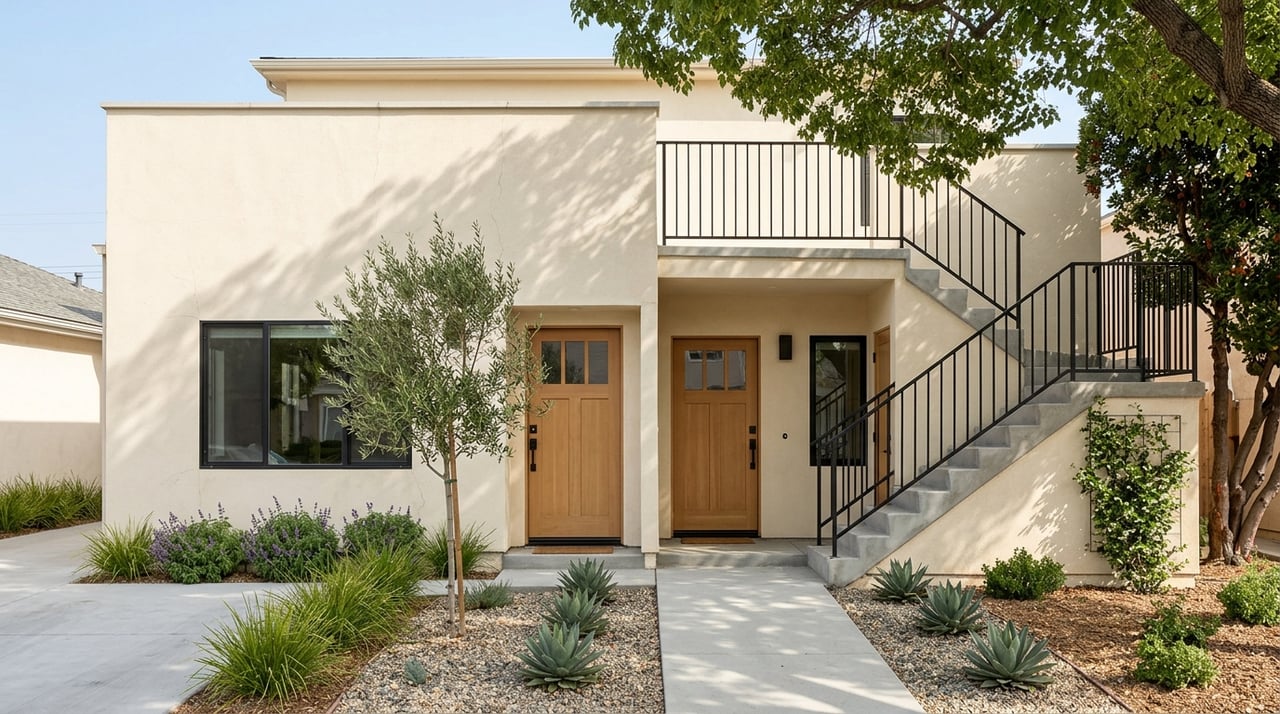
If you have been thinking about buying a small multifamily property in Burbank, you are not alone. In a city where housing costs are high and renting remains a major part of the market, a duplex, triplex, or fourplex can offer both flexibility and long-term planning potential. Whether you want to live in one unit, hold for income, or build toward a larger portfolio, understanding Burbank’s local rules and property conditions can help you make a smarter move. Let’s dive in.
Why Burbank Draws Multifamily Buyers
Burbank is a renter-supported market with a meaningful share of multifamily housing. According to the U.S. Census Bureau’s 2020-2024 estimates, the city’s homeownership rate was 43.3%, median gross rent was $2,192, and median owner-occupied home value was $1,089,100. That mix helps explain why small income properties continue to attract both owner-occupants and investors.
Burbank’s housing stock also includes more multifamily than many buyers expect. The city’s Housing Element reports that 10.5% of units are in 2-4 unit buildings, while 40.6% are in buildings with 5 or more units. In other words, small multifamily exists here, but it is a limited slice of the overall market.
Local employment also supports housing demand. Major employers named in the city’s Housing Element include Disney, Warner Bros. Entertainment, Providence St. Joseph Medical Center, Hollywood Burbank Airport, and Burbank Unified School District. For buyers, that means it is worth looking at small multifamily not just as a property purchase, but as part of a long-term real estate plan.
What Counts as Small Multifamily
In Burbank, small multifamily usually means duplexes, triplexes, fourplexes, and older low-rise apartment buildings. Each type can serve a different goal depending on whether you want to house hack, create rental income, or preserve future flexibility.
A duplex may appeal to owner-occupants who want to live in one unit and rent the other. A triplex or fourplex may offer more income streams, but it also brings more moving parts, from maintenance to tenant management. The right fit depends on your budget, timeline, and comfort with ownership responsibilities.
Start With Property Condition
Older buildings require closer review
Burbank is an older housing market. The city reports that about 74.7% of occupied housing stock was built before 1980. That matters because older multifamily properties can come with deferred maintenance, outdated systems, and larger capital expenses than first-time buyers expect.
The city also notes that major repairs often begin around 30 to 40 years of age. When you evaluate a property, look carefully at the roof, plumbing, electrical systems, exterior condition, and any signs of long-term wear. A property that looks fine at first glance may still need significant reserve planning.
Seismic due diligence matters
In Burbank, seismic status is not a minor detail. The city adopted a Mandatory Soft-Story Seismic Retrofit Ordinance effective January 10, 2025, covering certain wood-framed buildings with two or more stories built before January 1, 1978 and with a weak or open first floor.
The Housing Element estimates that roughly 600 to 800 multifamily buildings with 3 or more units include soft-story construction. If you are considering an older apartment-style building, you will want to confirm whether the property may be affected and what retrofit obligations or costs could apply.
Underwrite reserves conservatively
The Housing Element also estimates that about 2,760 multifamily units may need rehabilitation. That does not mean every building has major problems, but it does support a careful approach. If you are comparing two properties, the one with cleaner systems, better records, and fewer near-term repairs may be the stronger buy even at a higher price.
Check Zoning Before You Count on Upside
Many buyers look at small multifamily with plans to add value later. That can be a smart strategy, but in Burbank, zoning, design review, parking, and site constraints can all affect what is actually possible.
The city states that multiple-family projects and additions must go through development review. It also notes that properties in multiple-family zones may face added height and lot-coverage limits when they are within 500 feet of a single-family residential zone. So if your plan depends on adding square footage or reworking the site, do not assume the lot can deliver what you imagine.
In some multiple-family zones, a parcel with only a single-family home may be able to add units at the rear. But the city says parking and open-space standards can make those plans infeasible without demolition. That is a good reminder that “potential” only matters if it can survive real-world site rules.
ADUs and future expansion
If unit expansion is part of your strategy, Burbank updated its ADU and JADU standards in 2023 to align with state law. The city also publishes maps for parcels near transit that may qualify under state ADU rules. For some buyers, that opens another lane for long-term planning, but you still need to evaluate each parcel on its own facts.
Condo conversion is not simple
If you are thinking far ahead about resale strategy, Burbank requires condominium conversions of existing apartment buildings to go through an administrative use permit process and a tentative tract map application. That means a future condo-conversion exit should be treated as a specialized strategy, not a casual assumption.
Understand Rent Rules and Tenant Protections
Local compliance affects your numbers
Burbank has local tenant protections that matter for small multifamily buyers. The city’s Tenant Protection Ordinance applies to residential rental units covered by California’s Tenant Protection Act. It took effect on August 31, 2024, and a city amendment effective April 11, 2025 strengthened anti-harassment protections and adjusted relocation rules.
For buyers, this means your underwriting should reflect not just market rent, but the rules that shape rent increases, notices, relocation obligations, and day-to-day operations. A property is not just an asset on paper. It is also an ongoing compliance responsibility.
Know how rent increases work
Under California’s statewide rent cap, covered units generally cannot be increased by more than 5% plus CPI or 10%, whichever is lower, over any 12-month period. If a tenant moves out, a landlord may generally set a new initial rent on turnover, subject to local restrictions, affordability limits, and lease-specific obligations.
That makes current tenant mix and lease review especially important before you buy. A building with below-market rents may still have upside over time, but the path may be slower and more regulated than it appears in a quick listing summary.
Owner-occupant duplex buyers have a key local detail
If you plan to buy a duplex and live in one unit, Burbank has a local exemption worth understanding. A duplex is exempt from just-cause eviction provisions when the owner occupies one unit as a primary residence for the entire tenancy.
That does not remove every legal obligation, but it is an important local distinction for house hackers and live-in owners. If owner occupancy is central to your plan, you will want to evaluate how that status fits your financing, occupancy timeline, and long-term hold strategy.
Relocation rules can affect remodel plans
For no-fault evictions, Burbank requires relocation assistance of at least three months of the tenant’s current rent, with a narrow owner or relative move-in exception that requires at least one month of rent. The city also states that substantial remodels must be permit-based and generally require the tenant to vacate for at least 30 days.
If your business plan depends on quick renovations after closing, these rules matter. A value-add deal can still work, but only if your timing, budget, and expectations reflect the real process.
Operations Matter More Than Many Buyers Expect
Burbank launched a Housing Enforcement Unit in March 2025 to investigate housing complaints, provide landlord and tenant resources, accept certain claims, and pursue administrative or civil enforcement actions. In practical terms, that raises the importance of documentation, notices, lease compliance, and consistent operating practices.
There is also a local business-tax step to remember. The city says all businesses doing business in Burbank must register, and apartment owner rental applications are part of the city’s business-tax forms. Business tax certificates are also not transferable when ownership changes, so this should be part of your closing and post-closing checklist.
Budget Beyond the Purchase Price
Los Angeles County property taxes are generally limited to 1% of full cash value, plus voter-approved debt and direct assessments. But buyers should also plan for possible supplemental property tax bills triggered by a change of ownership or new construction. That can affect your first-year cash needs more than expected.
In a high-cost market like Burbank, conservative underwriting matters. Along with your mortgage, insurance, and utilities, you may need reserves for repairs, compliance costs, vacancy periods, and tax changes. A cleaner purchase often comes from asking hard questions early, not after escrow is well underway.
Think About the Bigger Plan
One of the best reasons to buy a small multifamily property is optionality. Depending on the asset and your goals, it can function as a house-hack, a long-term income property, or a step toward a larger portfolio. In the right situation, it may also support future exchange planning if the property is held for investment or business use.
Section 1031 can defer gain when an investment property is sold and replaced with other qualifying real property held for investment or business use. It does not apply to a primary residence or property held mainly for sale. That distinction is one reason it helps to think about your intended use before you buy, not just when you are ready to sell.
If your strategy is redevelopment rather than a simple hold, Burbank’s Inclusionary Housing Ordinance also matters. The city applies it to new construction of five or more residential units and requires 15% affordable housing, with rental projects split between very-low-income and low-income requirements. For most small buyers, that may be a future issue rather than an immediate one, but it is still part of the local planning picture.
A Smart Burbank Buying Checklist
Before you move forward on a small multifamily purchase in Burbank, focus on these items:
- Review the building’s age and condition in detail
- Confirm whether soft-story seismic rules may apply
- Study current leases, rent history, and occupancy status
- Verify local tenant protection rules that affect your plan
- Check zoning, parking, lot coverage, and development review requirements
- Evaluate whether ADU or expansion ideas are actually feasible
- Budget for business-tax registration and post-closing compliance
- Plan for property taxes, possible supplemental bills, and repair reserves
- Match the property to your long-term goal, whether that is owner occupancy, income, or future exchange planning
Buying a small multifamily property in Burbank can be a strong move, but it works best when you treat it as both a purchase and a strategy. The local market supports rental housing, yet older building stock, seismic issues, tenant protections, and city compliance rules all shape the real opportunity. If you want to buy with clarity and build around a longer-range plan, working through the details up front can help you protect both your cash flow and your future options.
If you are considering a duplex, triplex, fourplex, or small income property in Burbank, Marcellina Desousa can help you evaluate the numbers, the local rules, and how the purchase fits into your broader real estate plan.
FAQs
What types of small multifamily properties are common in Burbank?
- In Burbank, small multifamily usually includes duplexes, triplexes, fourplexes, and older low-rise apartment buildings, while 2-4 unit properties make up 10.5% of the city’s housing stock.
Can you buy a duplex in Burbank and live in one unit?
- Yes. Burbank’s local rules state that a duplex is exempt from just-cause eviction provisions when the owner occupies one unit as a primary residence for the entire tenancy.
What should you inspect before buying a small multifamily property in Burbank?
- You should closely review building age, roof, plumbing, electrical systems, exterior maintenance, seismic retrofit status, leases, rent history, and any city compliance obligations.
Do Burbank rent rules limit rent increases on small multifamily properties?
- Covered units generally follow California’s statewide rent cap, which limits increases to 5% plus CPI or 10%, whichever is lower, over any 12-month period.
Can rents be reset after a tenant moves out in Burbank?
- Generally yes, a new initial rent may usually be set on turnover, but you still need to check local restrictions, affordability requirements, and lease-specific obligations.
Are older multifamily buildings in Burbank more likely to need repairs?
- Often yes. Burbank is an older housing market, and the city notes that major repairs often begin around 30 to 40 years of age.
Does Burbank require soft-story seismic retrofits for some multifamily buildings?
- Yes. Burbank’s Mandatory Soft-Story Seismic Retrofit Ordinance applies to certain older wood-framed buildings with two or more stories and a weak or open first floor.
What extra local costs should you budget for when buying small multifamily in Burbank?
- In addition to the purchase price and regular property taxes, you should budget for possible supplemental property tax bills, repairs, reserves, seismic work if needed, and Burbank business-tax registration requirements.